Views: 0 Author: Pretank Marketing Team Publish Time: 2026-03-17 Origin: Site


Floating head heat exchangers are widely used in industries such as chemical processing, petrochemicals, power generation, and food production due to their ability to handle high temperatures and thermal expansion. Compared with other shell-and-tube heat exchanger designs, the floating head configuration offers greater flexibility, easier maintenance, and improved reliability under demanding operating conditions.
Understanding how a floating head heat exchanger works can help engineers and plant operators select the right equipment for efficient heat transfer and long-term process stability.
 A floating head heat exchanger is a type of shell and tube heat exchanger designed to allow the tube bundle to expand and contract freely during operation. This design helps prevent thermal stress caused by temperature differences between the shell side and tube side fluids.
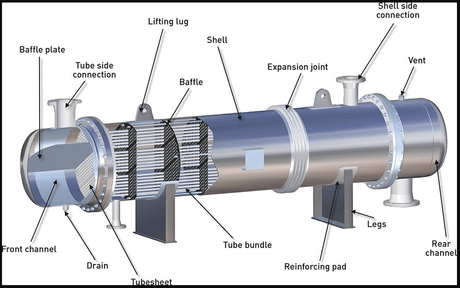
The main components typically include:
Shell – the outer pressure vessel that contains the shell-side fluid
Tube bundle – a group of tubes where the tube-side fluid flows
Tube sheets – plates that secure the tubes in place
Floating head assembly – a movable tube sheet that allows thermal expansion
Channel or front head – where the tube-side fluid enters and exits
Baffles – components that guide the shell-side fluid across the tubes to improve heat transfer efficiency
This structure enables efficient heat exchange between two fluids without mixing them.
The operation of a floating head heat exchanger follows the basic heat transfer principle of indirect heat exchange between two fluids.
One fluid flows through the tube bundle inside the exchanger. This fluid enters through the front channel and travels through the tubes before exiting at the outlet.
This fluid can be either the hot or cold medium, depending on the process design.
The second fluid flows through the shell side, surrounding the tube bundle. Baffles inside the shell guide the fluid across the tubes in a cross-flow pattern.
This design increases turbulence, which enhances heat transfer efficiency.
Heat is transferred through the tube walls from the hot fluid to the cold fluid. Because the fluids remain separated by the tube material, contamination between the two streams is prevented.
The rate of heat transfer depends on several factors, including:
Temperature difference between the fluids
Tube material thermal conductivity
Fluid velocity
Heat transfer surface area
One of the most important features of a floating head heat exchanger is its ability to accommodate thermal expansion.
When operating temperatures change, the tube bundle may expand or contract. In a floating head design, one tube sheet is fixed while the other is free to move within the shell.
This movable tube sheet — known as the floating head — allows the tube bundle to expand without causing mechanical stress or deformation.
In high-temperature industrial processes, thermal expansion can cause serious problems in fixed tube sheet exchangers. The floating head design solves this issue by allowing the tube bundle to move slightly during operation.
Key benefits include:
Reduced thermal stress on tubes and tube sheets
Improved reliability in high-temperature applications
Easier tube bundle removal for maintenance and cleaning
Longer equipment service life
Because of these advantages, floating head heat exchangers are commonly used in demanding environments such as chemical plants and refineries.
Floating head heat exchangers are suitable for processes that involve large temperature differences or frequent thermal cycling.
Typical applications include:
Chemical processing plants
Petrochemical and refinery systems
Power generation facilities
Oil and gas processing
Distillation systems
These industries require robust heat transfer equipment capable of maintaining performance under harsh operating conditions.
A floating head heat exchanger operates by transferring heat between two fluids through a tube bundle while allowing thermal expansion via a movable tube sheet. This design improves operational reliability, simplifies maintenance, and makes it ideal for high-temperature and demanding industrial applications.
For industries that require efficient heat transfer and durable equipment, floating head heat exchangers remain one of the most reliable solutions in modern process engineering.